

Workshop Details
DIMACS Tribute to the Many Facets of Fred Roberts
- Start Date: October 18, 2024
- End Date: October 18, 2024
- Event Start Time: 8:00 AM
- Event End Time: 8:00 PM
- Organizers: Alexis Tsoukiás | Tamra Carpenter | Margaret (Midge) Cozzens | David Pennock
- Event Location: The Rutgers Club | Livingston Campus
-
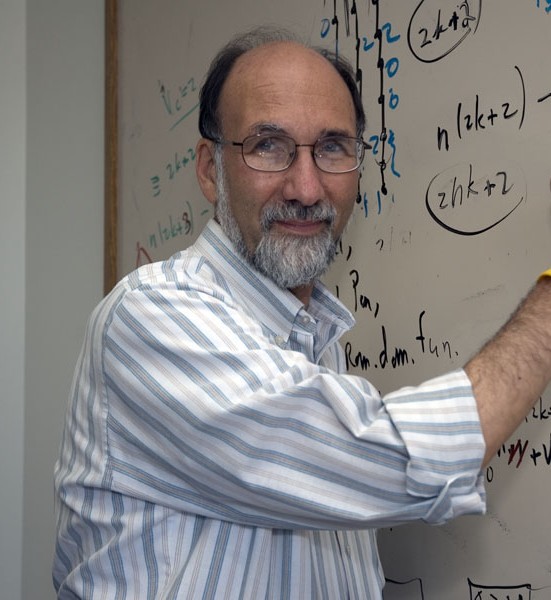
 The DIMACS Tribute to the Many Facets of Fred Roberts—aka FredFest—is a celebration of Fred’s contributions to both research and education in fields ranging from discrete mathematics, to mathematical biology, sustainability, homeland security, and the social sciences. Along the way, we will toast his 80th (and 81st) birthday and marvel at the connections that he has made, and continues to make, between disciplines and people. The event will immediately follow the 8th Conference on Algorithmic Decision Theory (a conference that Fred helped found), which will be held at Rutgers on October 14-16.
-
Thursday, October 17, 2024
Workshop Talks
8:00 AM – 9:00 AMBreakfast
9:00 AM – 9:20 AMOpening Remarks
Juli Wade - Executive Dean of the School of Arts and Sciences, Rutgers University , Prabhas Moghe - Executive Vice President for Academic Affairs, Chief Academic Officer, Rutgers University
9:20 AM – 9:40 AMPermutations from Random Walk
Peter Winkler - Dartmouth College
Fix a symmetric, continuous probability distribution on the real line, and use it for n steps of a random walk. The relative positions (i.e., partial sums) induce a permutation on the set {0,1,...,n}. A surprising amount can be said about these random permutations, independent of the distribution.
(Joint work with Peter Francis and Evita Nestoridi of Stony Brook University.)9:40 AM – 10:00 AMGraphs, Preferences, Algorithms and Decision Theory
Alexis Tsoukiás - Université Paris Dauphine
10:00 AM – 10:20 AMThe US-Africa Partnership in Biomathematics: Fred's Legacy of Visionary Leadership, Excellence, Collaboration and Mentorship
Abba Gumel - University of Maryland, College Park
Several Africa-based researchers (notably Edward Lungu then of the University of Botswana and his team) attended the AMS-IMS-SIAM Joint Research Summer Conference on "Competitive Mathematical Models of Disease Dynamics: Emerging Paradigms and Challenges" we co-hosted in Snowbird, Utah, 2005. At this meeting, Simon Levin suggested that we try to run similar events in Africa. He then connected us with Fred Roberts, who formed the US-Africa Partnership in Biomathematics (in conjuction with research centers in the US and in Africa) aimed at training and empowering US and African students, as well as junior researchers/scientists, and public health practitioners, on the use of mathematical sciences approaches and data analytics to model the spread and control of emerging and re-emerging infectious diseases that are relevant to the continent of Africa. The Partnership, which ran a series of research, training, and mentoring programs (in the form of a series of targeted Advanced Studies Institutes and workshops) mostly across sub-Saharan Africa (and the US too), achieved unprecedented success (by empowering countless trainees and junior scientists in Africa and the US). This lecture briefly summarizes Fred's amazing visionary leadership, hardwork, and tireless effort that made this possible, and some discussion on some of the specific projects that came out of the activities of the Partnership Fred formed.
10:20 AM – 10:40 AMBreak
10:40 AM – 11:00 AMRemarks
Rebecca Wright - Barnard College , Peter March - Rutgers University
11:00 AM – 11:20 AMThe Fred Is Right! An Application of Mathematics to Game Show Design
Paul Dreyer - Northrop Grumman
11:20 AM – 11:40 AMA New Local / Global Principle for Collectives
Dana Randall - Georgia Institute of Technology
11:40 AM – 12:00 PMFred’s Inspiring Creativity
Sasa Pekec - Duke University
Fred’s creative insights and ground-breaking mathematical modeling contributions have been formative for many careers. I will provide a personal perspective on the influence of Fred’s work from use of measurement theory ideas in algorithm design, to contributions to math modeling of social networks, to designing voting and resource allocation methods with desirable properties.
Bio:
Saša PekeÄ is the Peterjohn-Richards Distinguished Professor of Business Administration in the Decision Sciences Area at the Fuqua School of Business, Duke University. He earned his PhD in Applied Mathematics under supervision of Fred Roberts. Professor PekeÄ research is interdisciplinary and revolves around decision-making in complex competitive environments. He is a board member and the past president of the INFORMS Section on Auctions and Market Design, serves on editorial boards on several scientific journals, and has published in top academic journals in management sciences, operations research, economics, mathematics and psychology. Outside academia, Professor PekeÄ serves on the Supervisory Board of Atlantic Grupa, one of the leading FMCG companies in SE Europe, and was a member of the Council of Economic Advisors to the President of Croatia from 2010 to 2015.
12:00 PM – 1:30 PMLunch
1:30 PM – 1:50 PMThe Power of Mentorship: How Professor Fred Roberts Transformed My Life and Empowered Communities Across Africa and the Global South
Jude Kong - University of Toronto
1:50 PM – 2:10 PMBeyond DIMACS - How Fred has Helped Shape the Lives and Disciplines of Researchers He's Never Even Met
Nina Fefferman - University of Tennessee
Few researchers have the depth and breadth of Fred's research accomplishments, but in this talk, rather than focusing on his research contributions, I'll discuss just a few of the many ways in which Fred has influenced the work of others as a director and mentor.
Bio:
Nina Fefferman is a professor at University of Tennessee in the departments of Mathematics and Ecology & Evolutionary Biology, where she is also both the director of the National Institute for Modeling Biological Systems (NIMBioS) and of the recently founded US NSF Center for Analysis and Prediction of Pandemic Expansion (APPEX). Before that, Fefferman spent a decade in residence at DIMACS (and DyDAn and then CCICADA), the experience of which shaped her understanding of what a thriving center can accomplish - a legacy she tries to honor daily.2:10 PM – 2:30 PMFred Roberts, Infectious Diseases and African Science
Simon Levin - Princeton University
Fred Roberts has been a great Center leader for decades, and has used that role to foster the further development of modelling infectious diseases, with a proactive outreach to African researchers and others working on infectious diseases in Africa. This talk will briefly review those efforts and then identify some key expansions of the mathematical theory of infectious diseases from the past decade, especially those spurred by the COVID pandemic.
2:30 PM – 3:20 PMPanel Discussion: Fred's Work on Homeland Security
Andrew Tucci - United States Coast Guard , Steve Keleman Director, - Rutgers University Emergency Management , Paul Kantor - Rutgers University (retired) , Mitch Erickson - Department of Homeland Security (retired) , Elsayed A. Elsayed - Rutgers University , Dennis Egan - CCICADA , Alok Baveja - Rutgers University
3:20 PM – 3:40 PMBreak
3:40 PM – 3:50 PMRemarks
Joseph Rosenstein - Rutgers University , Chuck Biehl - Charter School of Wilmington (retired)
3:50 PM – 4:10 PMFrom Food Webs, to Channel Assignments, to Tools of Psychology, and Back Again
Margaret (Midge) Cozzens - DIMACS
4:10 PM – 4:30 PMFrom Yosemite to Guide Dogs: How Growing Up a Roberts Helped me (Re-)Invent Animal-Centered Computing
David Roberts - North Carolina State University
In this talk I'll share some anecdotes from my childhood, growing up as Fred's son and share how they've helped to shape my professional life decades on. From discussions of decision analysis, to randomized algorithms for airport security, and the one way street problem, my childhood in the Roberts family was always filled with real world applications of mathematics. It wasn't until graduate school when I realized those discussions had been formative for me, when one day I realized that my propensity to use math to win arguments with random people on the internet may actually reflect a deeper research agenda. I'll describe some of the formative arguments that helped me to "invent" Animal-Centered Computing (only to later realize others had explored the idea decades earlier). I'll conclude this brief talk with some results from a long-running collaborative project where we've deployed technology to help guide dog organizations gain efficiency and improve the lives of people with visual disabilities---contributions I maintain are due in large part to growing up a Roberts.
Bio:
Dr. David L. Roberts is the Assistant Director of Undergraduate Programs and an Associate Professor of Computer Science, North Carolina State University. He has a particular focus on computation as a tool to provide insight into human and nonhuman animal behavior in narrative, virtual world, and game environments. His laboratory regularly works with leading non-profit service animal and animal welfare organizations to bring the power of algorithms and analytics to bear on the challenging problems of understanding (human and non-human) animal behavior. His research interests lie at the intersection of machine learning, social and behavioral psychology, and human–computer interaction. Roberts regularly works in collaboration with faculty and industry representatives from fields outside Computer Science, particularly in the veterinary and agricultural sciences.
4:30 PM – 4:50 PMMath + Your (solve for x) Interests = Research Findings that Make a Difference
Sarah Roberts - University of California, San Francisco
Bio:
Sarah Roberts, DrPH, is a Professor and Legal Epidemiologist in the Department of Obstetrics, Gynecology, and Reproductive Sciences, at the University of California, San Francisco. Dr. Roberts' current research evaluates maternal and child health impacts of state-level pregnancy-specific alcohol and drug policies and of state-level abortion policies. She also conducts research to understand health care providers’ decision making regarding reporting pregnant and birthing people who use alcohol and drugs or who are self-managing an abortion to government authorities. Dr. Roberts has published more than 120-peer reviewed manuscripts and has received grant funding from private foundations, the NIH, and other government agencies. Dr. Roberts received her undergraduate degree in history from Columbia University, MPH and a Graduate Certificate in Women’s Studies from the University of Michigan, and DrPH from the University of California, Berkeley.
4:50 PM – 5:10 PMOpen Mic
Fred Roberts - DIMACS
6:00 PM – 8:00 PMDinner