

Workshop Details
DIMACS Workshop on Forecasting: From Forecasts to Decisions
- Start Date: March 18, 2021
- End Date: March 20, 2021
- Event Start Time: 9:00 AM
- Event End Time: 5:00 PM
- Organizers: Bo Waggoner | David Pennock | Raf Frongillo
- Location: Online Event
-
Following the successful EC 2017 Workshop on Forecasting, we will hold the DIMACS Workshop on Forecasting in 2021. We welcome submissions describing recent research on crowd-sourced, data-driven, or hybrid approaches to forecasting. We especially encourage contributions that leverage forecasts to improve decisions. Please see the Call for Participation below for details.
Recent advances in crowdsourced forecasting mechanisms, including Good Judgment’s superforecasting, prediction markets, wagering mechanisms, and peer-prediction systems, have risen in parallel to advances in machine learning and other data-driven forecasting approaches. Innovations have come from academic researchers, companies, data journalists, and government programs like IARPA’s Aggregative Contingent Estimation program and Hybrid Forecasting Competition.
The workshop will emphasize forecasts embedded inside decision-making systems, where the value of a forecast comes from increasing the expected utility of a key decision. Our ultimate goal is to modernize organizations, markets, and governments by improving how they collect and combine information and make decisions.
The workshop embraces the diversity of this exciting and expanding field and encourages submissions from a rich set of empirical, experimental, and theoretical perspectives. We invite theoretical computer scientists studying algorithmic game theory, incentivized exploration, and NP-hard counting problems; AI researchers studying machine learning, human computation, Bayesian inference, peer prediction, and satisfiability; statisticians studying scoring rules and belief aggregation; economists studying prediction markets, financial markets, and wagering mechanisms; data journalists and marketing scientists studying surveys and polls; blockchain pioneers implementing decentralized prediction markets and other experimental market constructs; social and behavioral scientists studying human behavior modeling; human-computer interaction researchers designing interfaces to facilitate elicitation or convey uncertainty; and practitioners working to improve forecasts as a business or service.
Uncertainty is hard to communicate. Forecasters argue that they are “right”, and critics that forecasters are “wrong” (for example about Brexit or the US Presidential election), despite the fact that probabilistic forecasts can only be evaluated in bulk relative to other forecasts. We invite contributions discussing ways to communicate uncertainty and educate the public about modeling, forecasting, and scoring, building on the excellent 2018 Nova episode “Prediction by the Numbers”.
Topics of interest for the workshop include but are not limited to:
- Incentives in forecasting. Methods for eliciting truthful and accurate forecasts or information.
- Coordinating groups of participants to collectively forecast. Examples include prediction markets and wagering mechanisms.
- Connections between human- and machine-driven forecasting. Uses of data, models, or machine learning in forecasting, and theoretical connections between forecasting mechanisms and machine learning techniques.
- Making complex forecasts. Predicting structured, combinatorial, or multi-part events. Making conditional forecasts. Forecasting continuous distributions, exponential-sized joint distributions, and spatiotemporal distributions.
- Forecasting metrics related to climate, the environment, transportation, renewable energy, or public health. For example, metrics of a pandemic including number infected, number hospitalized, number killed, and fatality rate by region and over time, conditioned on public health policies.
- Forecasting in support of decision making by companies, organizations, or governments.
- Visualization and other best practices for communicating uncertainty and educating the public about forecasts.
-
Wednesday, March 17, 2021
Workshop Talks
9:00 AM – 10:10 AMWelcome & Opening Remarks
10:00 AM – 10:45 AMInvited Talk: How to Increase the Accuracy of Human Forecasts and Check the Reasons for Improvement
Ville Satopää - INSEAD , Barbara Mellers - University of Pennsylvania
10:10 AM – 11:05 AMAsymptotic Behaviour of Prediction Markets
Philip Dawid - University of Cambridge
10:45 AM – 11:25 AMTimely Information from Prediction Markets
Chenkai Yu - Tsinghua University
11:05 AM – 12:10 PMInvited Talk: A Heuristic for Combining Correlated Experts
Yael Grushka-Cockayne - University of Virginia
11:35 AM – 1:00 PMView Posters & Videos
12:10 PMList of Posters
Human Forest vs. Random Forest in Time-Sensitive COVID-19 Clinical Trial Prediction
Pavel Atanasov (Pytho) & Regina Joseph (Pytho)
[Video]From Forecast to Decisions in Graphical Models: A Natural Gradient Optimization Approach
Eric Benhamou (University of Paris Dauphine)
[Video]Property Elicitation for Evaluating Complex Forecasts
Ian Kash (University of Illinois, Chicago)How to Increase the Accuracy of Human Forecasts and Check the Reasons for Improvement
Barbara Mellers (University of Pennsylvania) & Ville Satopää (INSEAD)
This poster is associated with a talk given earlier in the day. [Presentation video]Efficient Competitions and Online Learning with Strategic Forecasters
Anish Thilagar (University of Colorado)
[Video]Designing a Combinatorial Financial Options Market
Xintong Wang (University of Michigan)Truthful Information Elicitation from Hybrid Crowds
Thursday, March 18, 2021
Workshop Talks
10:00 AM – 10:35 AMInvited Talk: Predicting Replication Outcomes
Anna Dreber - Stockholm School of Economics
10:35 AM – 10:55 AMFrom Proper Scoring Rules to Max-Min Optimal Forecast Aggregation
Eric Neyman - Columbia University
10:55 AM – 11:15 AMForecast Aggregation via Peer Prediction
Juntao Wang - Harvard University
11:15 AM – 11:35 AMComparing Forecasting Skill vs Domain Expertise for Policy-Relevant Crowd-Forecasting
Emile Servan-Schreiber - Mohammed VI Polytechnic University
11:35 AM – 12:10 PMForecasting Startup Founders Panel
Emile Servan-Schreiber - Hypermind , Kelly Littlepage - OneChronos , Andreas Katsouris - PredictIt , Pavel Atanasov - pytho
12:10 PM – 1:00 PMView Posters & Videos
List of Posters
Advice Auctions
Nicolas Della Penna (MIT)
[Video]From Proper Scoring Rules to Max-Min Optimal Forecast Aggregation
Eric Neyman (Columbia University)
This poster is associated with a talk given earlier in the day. [Presentation video]Decision Scoring Rules
Caspar Oesterheld (Duke University)
[Video]The Wisdom of The Crowd and Higher-Order Beliefs
Mallesh Pai (Rice University)Comparing Forecasting Skill vs Domain Expertise for Policy-Relevant Crowd-Forecasting
Emile Servan-Schreiber (Mohammed VI Polytechnic University)
This poster is associated with a talk given earlier in the day. [Presentation video]Forecast Aggregation via Peer Prediction
Juntao Wang (Harvard University)
This poster is associated with a talk given earlier in the day. [Presentation video]Two Strongly Truthful Mechanisms for Three Heterogeneous Agents Answering One Question
Fang-Yi Yu (Harvard University)Truthful Data Acquisition via Peer Prediction
Shuran Zheng (Harvard University)1:00 PM – 1:30 PMSocial Event
Friday, March 19, 2021
Workshop Talks
10:00 AM – 10:35 AMInvited Talk: Information, Incentives, and Goals in Election Forecasts
Andrew Gelman - Columbia University
10:35 AM – 10:55 AMModels, Markets, and the Forecasting of Elections
Rajiv Sethi - Columbia University
10:55 AM – 11:15 AMBoosting the Wisdom of Crowds Within a Single Judgment Problem: Weighted Averaging Based on Peer Predictions
Ville Satopää - INSEAD
11:15 AM – 11:35 AMCrowdsourced Forecast Elicitation: Methods vs. Individuals
Pavel Atanasov - pytho
11:35 AM – 12:10 PMInvited Talk: Models vs. Markets: Forecasting the 2020 U.S. election
Harry Crane - Rutgers University
12:10 PM – 1:00 PMView Posters & Videos
List of Posters
General-Domain Truth Discovery via Average Proximity
Reshef Meir (Technion-Israel Institute of Technology)Models, Markets, and the Forecasting of Elections
Rajiv Sethi (Columbia University)
This poster is associated with a talk given earlier in the day. [Presentation video]Boosting the Wisdom of Crowds Within a Single Judgment Problem: Weighted Averaging Based on Peer Predictions
Ville Satopää (INSEAD)
This poster is associated with a talk given earlier in the day. [Presentation video]Information Elicitation Mechanisms for Statistical Estimation
Biaoshuai Tao (Shanghai Jiao Tong University)
[Video]Learning and Strongly Truthful Multi-Task Peer Prediction: A Variational Approach
Fang-Yi Yu (Harvard University)Information Elicitation from Rowdy Crowds
Yichi Zhang (University of Michigan)
[Video]The Limits of Peer Prediction
Shuran Zheng (Harvard University)5:00 PMPoster Session 1
Poster Session 3
Panel - Moderator: David Pennock, DIMACS
-
Attend: This workshop is open to all to attend, but you must register using the link at the bottom of the page. We will send instructions on how to join the event on or before March 15, 2021. If you do not receive them, please check your spam folder or
This email address is being protected from spambots. You need JavaScript enabled to view it. . Please note that you may not be able to register once the event has begun.Present: We invite both full contributions and poster contributions. A full contribution is an unpublished or recently published research manuscript. A poster contribution can be a preprint, a recently published paper, an abstract, or a presentation file. Preference may be given to more recent and unpublished work. We especially encourage poster contributions from students and postdocs.
Please submit your contributions using this Google Form by February 19, 2021. The workshop is non-archival, meaning contributors are free to publish their results later in archival journals or conferences. Panel discussion proposals and invited speaker suggestions are also welcome. Email questions or suggestions to the organizers.
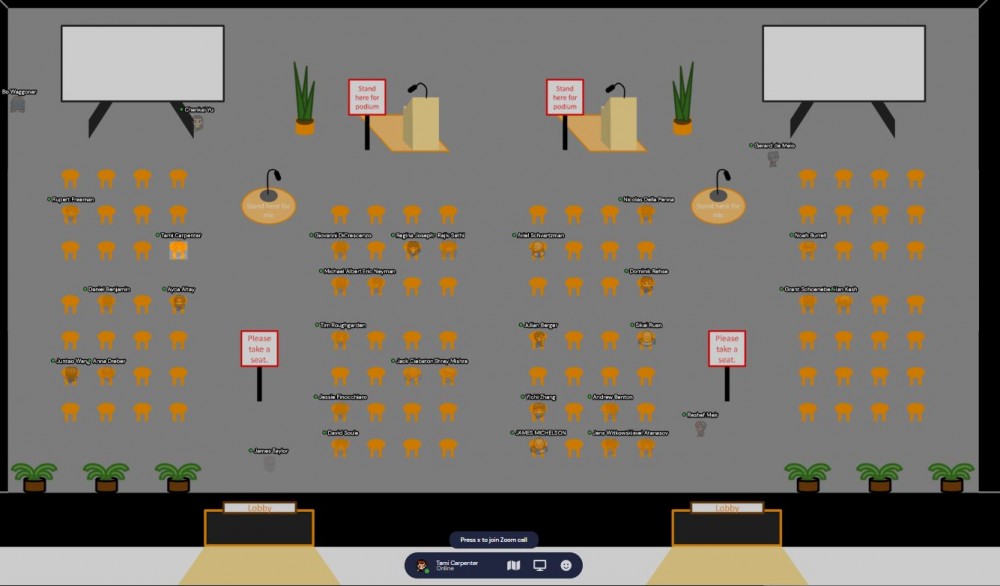
The workshop will include invited and contributed talks, open discussion, and may include a poster session and a rump session. Workshop registration will be open. Once registered, you will join the workshop through Virtual Chair.
Important Dates:
- Submissions due: Friday, February 19, 2021
- Notifications: Wednesday, March 3, 2021
- Workshop: March 17-19, 2021