

On July 8, 2026, Henry Pollak passed away at the age of 98. Henry was a towering figure with a tremendous influence on both DIMACS and COMAP, the Consortium for Mathematics and its Applications. (See COMAP's tribute to Henry). Here are my memories of Henry.
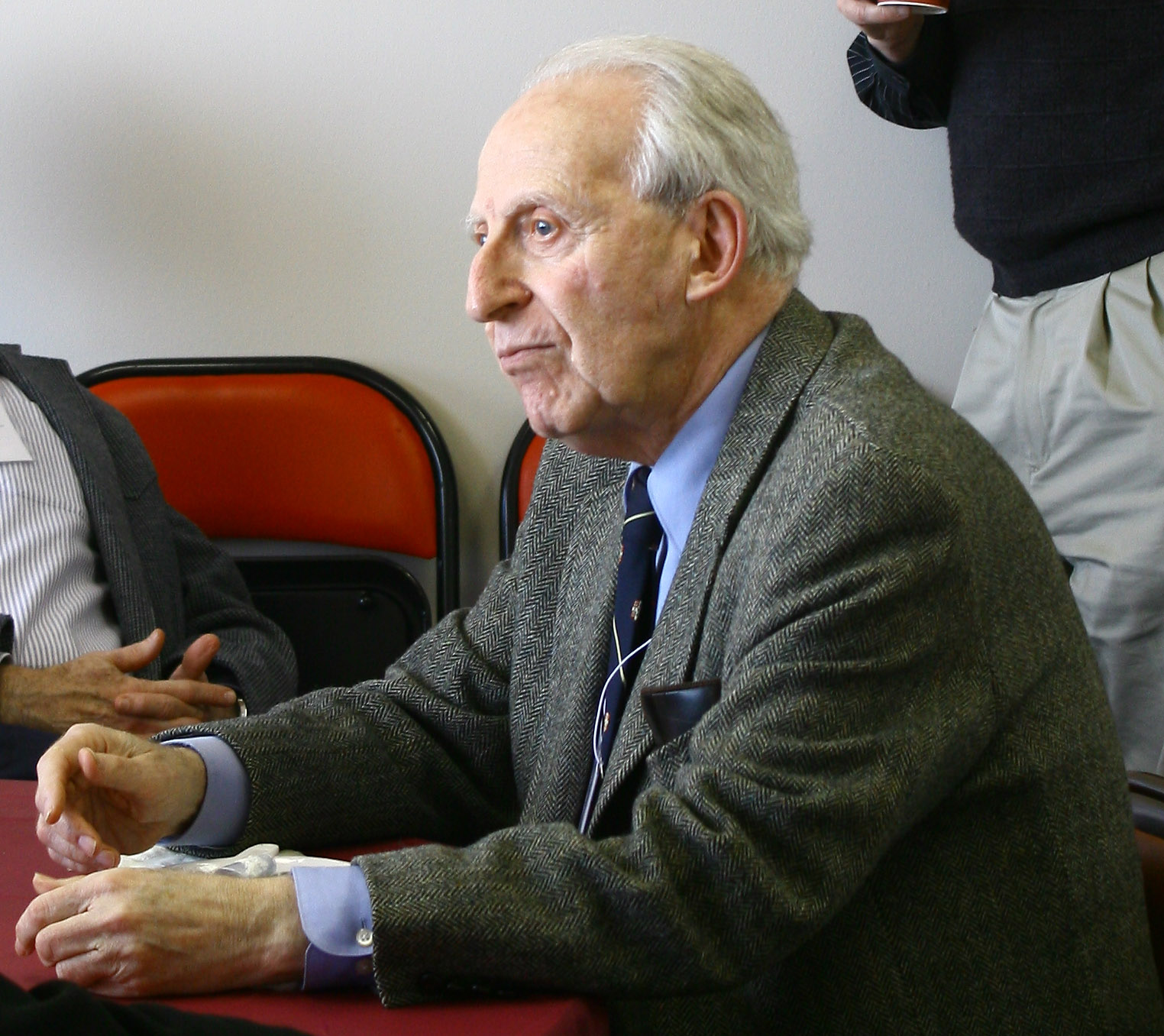 I first met Henry Pollak in the early 1980’s as we both began to engage seriously with Sol Garfunkel about the founding and development of COMAP, the Consortium for Mathematics and its Applications, and a few years later with Dan Gorenstein and Fred Roberts in the proposal to fund DIMACS, the Center for Discrete Mathematics and Theoretical Computer Science at Rutgers. I served on the COMAP Board with Henry from 1987 to 1991 when I went to NSF. He remained on the Board until 1996. Our paths continued to cross for the better part of the next 40 years, including attending a symphony at the Kennedy Center in the 1990’s. He was so well known it was like going with royalty.
I was reminded of Henry and our many conversations a few months ago, when I attended a series of lectures at Rutgers focusing on Hyman Bass and his engagement in mathematics education. As Suzanne Wilson and Deborah Ball talked about Hyman and his contributions to mathematics education, particularly elementary mathematics teaching, I saw many parallels with Henry and his work. Suzanne described Hyman as a rooted public intellectual—a public intellectual who is open to learning from the public, as well as offering his expertise. Hyman as an academic, brings a certain authority to what he says, especially among other mathematicians. Henry did not come from a position in academia, but a position in industry, as head of the Mathematics and Statistics Research division of Bell Laboratories; yet, he too engaged deeply in mathematics education. During these talks, I asked myself what type of public intellectual Henry might be. His Ph.D. from Harvard in “pure” mathematics gave him some authority, but not among academics in general who tend to measure a colleague’s gravitas by the number of publications and awards. Henry’s substantial authority was rooted, instead, in the quality and extensiveness of his interactions with teachers, researchers, and others.
A tall and distinguished man, Henry was imposing. While still at Bell Labs in the 1950’s, he helped revise mathematics curricula at every level, in the 1970’s he gave lectures at MAA meetings on modelling (he was the first nonacademic president of MAA), and in the 1980’s he taught courses each summer at the Woodrow Wilson National Fellowship Foundation’s Summer Mathematics Institutes for 50 high school teachers from across the country. In 1984, the Institutes began to focus on statistics, ultimately leading to the inclusion of statistics at every level of mathematics K-12. As Landy Godbold, a high school teacher from Georgia who attended many Institutes, said of Henry, “He delighted from learning from participants new ways to solve old problems.” Henry loved talking education and mathematics with young and old alike, and learning from them, he too was a rooted intellectual.
In 1986 Henry retired from Bell Labs after 35 years, and one year later he decided to devote his waking hours to mathematics education and became a visiting professor of Mathematics Education at Teachers College Columbia. He remained in that position for over 38 years until his recent death. While at Teachers College he taught classes, supervised doctoral students, and wrote numerous curricular pieces on modelling, including the still super popular Math Trails for COMAP with Joel Schnieider from Children’s Television Workshop, and Mary Margaret Shoaf. Math Trails is a 2004 book that serves as a guide for creating and implementing math trails—structured walks that uncover mathematical problems in everyday environments, helping students to see math outside the classroom.
In the late 1980’s and early 1990’s, Henry fully engaged with the work of COMAP. He wrote Henry’s Notes for Consortium, a COMAP produced newspaper published four times a year and mailed free to every high school mathematics teacher, now published twice a year. (Note: I was the editor of Consortium for ten years from 1981 to 1991. During this time, I frequently sought Henry’s advice and ultimately enlisted him to write Henry’s Notes when he retired from Bell Labs.) In the 1990’s COMAP successfully submitted a proposal to NSF to develop a full set of high school mathematics curriculum materials. Henry was one of the primary authors and reviewers of these materials, especially as they focused on mathematical modelling in the world.
Henry stayed connected to the colleagues he collected along the way. Even after moving to Columbia, he remained involved with DIMACS. In the early days of DIMACS, Henry was on the Scientific Advisory Board as the “External Education member”. He served on the steering committee for the DIMACS Research and Education Institute (DREI) from 1996 to 1998, he wrote an article, “Mathematical Modeling and Discrete Mathematics” for the DIMACS book Discrete Mathematics in the Schools, he spoke at the DIMACS Conference “New Perspectives in Mathematics Education” in 2002, and joined me in panels on education at conferences celebrating the 10th and 20th birthdays of DIMACS in 1998 and 2009.
Henry’s influence on COMAP and DIMACS cannot be overstated. He made education front and center for both organizations from day 1. He established connections with Bell Labs and other companies. He helped enlist the many people who contributed to the longevity of both organizations, each of which continues to thrive to this day.
Henry always put teachers in centerstage, both teaching them and learning from them. Henry forever reminds me of one of my favorite authors, E.B. White, author of Charlotte’s Web, who used a pig, Wilbur, and a spider, Charlotte, to teach problem solving and logical thinking to children. Problems are not always easy to solve, whether capturing food or saving a life. Charlotte spent considerable time “thinking of an idea” to save Wilbur’s life, before she decided to spin a web that said “SOME PIG”, making Wilbur attractive for himself, not just as food. As Wilbur says of Charlotte at the end of the book, “we won’t forget” Henry Pollak. His teachings about solving problems, mathematical modelling, and logical thinking live on. As does his generous spirit and deep interest in and respect for teachers and their students.
Margaret (Midge) Cozzens,
Distinguished Research Professor and Director of Education for DIMACS at Rutgers
Collaborator on numerous module projects with COMAP and former Board Member